 SavingRabbit
What your AI coding spend shipped, and where to save.
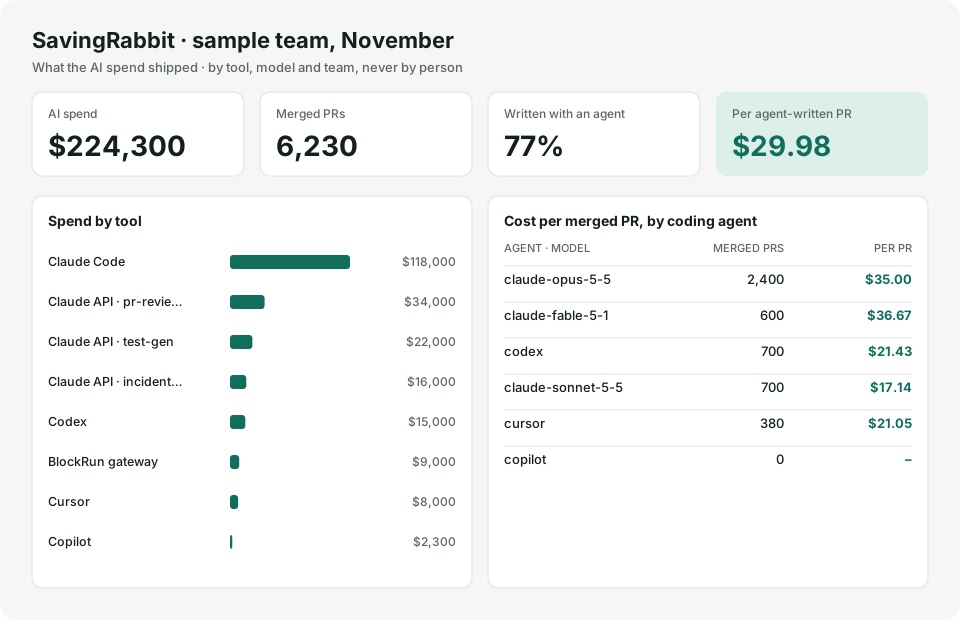
Your team pays Anthropic, OpenAI, Cursor and GitHub for AI. Each bill tells you what you spent. None of them tells you what it bought. SavingRabbit joins the bills to the pull requests that merged and prices every one.

git clone https://github.com/BlockRunAI/savingrabbit && cd savingrabbit
python3 savingrabbit.py pull-local --since 2026-11-01 --until 2026-11-30 --repo ~/code/app
python3 savingrabbit.py report
Measure, replay, route.
Cost per merged PR
Pulls spend from each vendor's own admin API and reads which agent and model wrote each merged PR from the Co-Authored-By trailers your agents already leave. Reports by tool, model and team.
Which tasks need the top model
Re-runs real tasks on cheaper models through one BlockRun key, records what each call cost, and checks every answer against the output your team accepted.
Switch with evidence
Picks the cheapest model that held your quality bar and writes the /model and /exclude settings for ClawRouter, the open-source router.
One read-only credential per source.
Start with no keys at all: pull-local reads only the token counts in your own Claude Code logs, never prompts or outputs. Add each team source when you're ready.
Read it in one sitting.
One Python file, standard library only. It runs on your machine, talks only to the vendors you point it at, and keeps no account and no telemetry.
- Read-only. GET requests and one read-only search. It never writes to a vendor.
- Teams, not people. It reads per-person data where vendors publish it that way, and reports only by team.
- Keys stay in your shell. Read from environment variables, never written to disk or printed in errors.
- Honest about limits. A merged PR is not value, and cost per PR is a window ratio. The README says so.
Free to measure. Pay when you act on it.
SavingRabbit
- Cost per merged PR by tool, model and team
- Personal mode with no keys
- Dashboard, report, JSON export
- Apache 2.0, runs on your machine
Replay and route on BlockRun
- One key for every major model: Claude, GPT, Gemini, DeepSeek and more
- Replay your real tasks on cheaper models and see the exact cost of each call
- Move the work that passes onto ClawRouter
- Top up by card. No subscription, no minimum
Two-week AI spend review
- Your real AI bill, read-only access, reported by team and tool
- Your top task types replayed on candidate models, 200–500 cases each, with proper grading
- A model-per-task plan, with the quality evidence behind it
- Then optional monitoring from $3K a month: we re-test whenever a new model ships
Questions teams ask first
How much does Claude Code cost per pull request?
It varies widely by team and model, which is why it's worth measuring. Run pull-local for yourself, or pull-claude-code plus pull-github for a team, then report.
How do I measure the ROI of Cursor, Copilot or Codex?
Connect each tool's admin API and compare cost per merged PR across tools. Copilot is billed per seat, so its cost is seats times your seat price.
Can I track AI coding spend by team without tracking individuals?
Yes. Map emails and GitHub logins to teams in a CSV. Spend and merged PRs roll up to teams, and the report never shows a person.
Does it send my code or prompts anywhere?
No. It reads usage counts and git metadata locally. Only the optional replay command sends the sample prompts you choose to BlockRun's gateway, so use samples with secrets removed.
Is it free?
The tool is free under Apache 2.0, including commercial use inside your company. Replays run on a BlockRun key at each model's list price plus a 5% platform fee. The two-week review and ongoing monitoring are paid services from BlockRun.
Can a small sample tell me which cheaper model to use?
A sample can rule out models that clearly fail. Deciding that a cheaper model holds your quality bar needs a few hundred cases per task type and grading that fits the task. That is what the two-week review does.